Automatically translated from German. The German original is authoritative. German version
What helps with chronic pain?
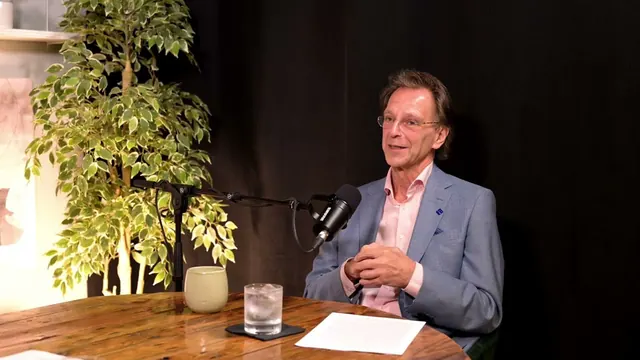
 Chronic pain. With Dr. med. Alexander Loizides, Innsbruck Medical University. Hosted by Prof. Dr. Peter Minko.
The episode in 60 seconds
Pain in the musculoskeletal system is very common: back, knee, osteoarthritis, irritated tendons. According to WHO data, this affects over 1.5 billion people.
For carpal tunnel syndrome, Loizides splits the constricting ligament from the inside, under ultrasound, through a 3-millimeter incision. Outpatient, in about 3 minutes, without a cast.
With osteoarthritis and irritated tendons, pathological small vessels grow into the tissue. If they are closed off, the pain can subside.
Embolization does not help with mechanical problems like a pinched meniscus or pain originating from the spine.
Chronic pain: What radiology can specifically do about it
From episode 02 with Dr. med. Alexander Loizides8 min read
Pain in numbers Now playing
Pain in the musculoskeletal system is not a niche topic. According to data from the World Health Organization (WHO), over 1.5 billion people suffer from it. The most common is back pain, followed by knee pain, osteoarthritis, and tendinopathies.
Tendinopathies are pathological changes in tendons, for example in the Achilles tendon, the elbow, or the sole of the foot. The tendon thickens, small vessels grow into it, and that is painful. By the way, you don't need sports for a tennis or golfer's elbow. Working with a computer mouse can also be enough.
Loizides works a lot with ultrasound. Its biggest advantage: You can see in real-time how a joint or a finger moves. Modern transducers show nerves that are thinner than half a millimeter.
„You can move a joint or a finger in real-time.“
When the hand tingles at night Now playing
Carpal tunnel syndrome is the most common condition in which a nerve is compressed. At the wrist, the median nerve runs through a tunnel over which a strong ligament stretches. If it gets too tight there, it presses on the nerve. Every year, about 1 to 3 out of 1,000 people develop the condition.
Tingling and sensory disturbances in the thumb, index, and middle finger and on the inside of the ring finger are typical. The pain often occurs at night. In advanced stages, muscle atrophy can occur.
„Carpal tunnel syndrome is the most common compression neuropathy.“
3 millimeters instead of 3 centimeters Now playing
In open surgery, one makes an incision of about 3 centimeters in the palm of the hand, exactly where the hand is stressed when gripping. Loizides gets by with a 3-millimeter incision, about 2 centimeters above the wrist. Nothing needs to be sutured.
„I always say: 3 millimeters instead of 3 centimeters.“
A prerequisite is a neurological finding: The measurement of nerve conduction must confirm the carpal tunnel syndrome.
Ultrasound of the hand to rule out other causes such as a ganglion or a tumor.
Outpatient and with local anesthesia. The hand lies stretched out on a splint.
Through the tiny incision, a button cannula and a hook knife are inserted. Under ultrasound guidance, the ligament is split from the inside.
During the procedure itself, it is checked whether the ligament is completely severed.
Plaster and pressure bandage, no cast. The hand should be moved immediately.
Check-up after two weeks, again with ultrasound.
According to Loizides, the nocturnal pain usually disappears on the first day. The numbness from the anesthesia lasts for a few days. Complications are very rare. The fact that the ligament is not completely severed occurs in the per mille range and can be corrected immediately.
Closing off vessels to combat pain Now playing
Embolization means: closing off vessels in a targeted manner. With osteoarthritis or irritated tendons, pathological small vessels grow into the tissue. They are disorganized, with constrictions, blockages, and shunts. If they are closed off, the pain can subside.
Classically, this is done via a catheter, usually from the groin, to the small feeding arteries. For the hand, elbow, knee, and foot, there is a variant from Japan, developed by Yuji Okuno: A small artery nearby is punctured directly with a very fine needle. Then, tiny spheres are injected, which quickly dissolve again.
The trick: In healthy vessels, the spheres dissolve immediately. In pathological vessels, they get stuck and close them off until they also dissolve after at most two hours. A blood pressure cuff ensures that the agent collects where it is supposed to have an effect. The actual procedure takes only seconds.
„Everything feels light. That is what I hear so often now.“
Not everyone responds to the treatment. Those who do experience improvement often notice it after the first puncture. If necessary, it can be repeated a second or third time.
Where it can help Now playing
Peter Minko mentions symptoms, and Loizides rates on a scale of 1 to 10 how suitable the needle method is. Where he prefers to work classically with a catheter, he says so. This is his personal experience, not a guideline and not a success rate.
All of these complaints have one thing in common: pathological new vessels in the tissue. You cannot see them from the outside, but you can see them in ultrasound or MRI.
Who it is not suitable for and what the data says Now playing
Embolization does not help with mechanical problems, such as a pinched meniscus or impingement in the hip joint. Loizides also does not treat pain that radiates from the spine this way.
For classic embolization, he mentions a benefit in about 70 to 75 percent of patients. Larger studies on the needle method are still ongoing; his initial experience puts it at 60 to 70 percent. Both speak openly about the fact that a placebo effect also plays a role in pain treatments. However, the data on classic embolization show a lasting effect.
As with any puncture, bleeding, infection, or injury to a vessel or nerve can occur. Because the work is done under ultrasound, this is very rare.
For everyone, but in experienced hands Now playing
Loizides has written a book about the method with Yuji Okuno. One idea in it: The treatment should be accessible to everyone, even in countries without an angiography suite, where there is only an ultrasound machine. Nevertheless, he believes it belongs in experienced hands. It is not just about placing the needle in the vessel. You also need to know which nerve is right next to it.
Next
Same question, other experts
Surgery or radiology?
2 experts answer
How does a treatment work?
3 experts answer
Why interventional radiology?
3 experts answer
What can be treated?
4 experts answer

What can interventional pain therapy achieve?
Treating pain in a targeted manner
 Dr. med. Elif Can, M.A.
 Dr. med. Cornelia Dewald
 Prof. Dr. med. Thomas Helmberger